

Walking Gear
Best No-Pull Dog Harnesses

"No-pull" is a product category, not a guarantee. All three harnesses here have a leash ring at the chest, and two also have a second ring. They don't train your dog for you.
We picked three designs with a chest attachment and deep rating bases. Below them is what the studies found about collars, harnesses and how hard dogs pull, including results that don't fit the usual marketing.
Our 3 picks at a glance
- Best Overallrabbitgoo No-Pull Dog Harness (Medium)Padded vest with front and back leash rings and a top handleCheck price on Amazon (opens Amazon in a new tab)
- Best Lightweight Front-ClipPetSafe Easy Walk Harness (Medium)Minimal 3.88 oz strap harness with a martingale loopCheck price on Amazon (opens Amazon in a new tab)
- Best Velvet-Lined2 Hounds Design Freedom No-Pull Harness (1" MD)Velvet-lined, two connection points, made in the USA per listingCheck price on Amazon (opens Amazon in a new tab)
How we picked
We searched Amazon for no-pull dog harnesses and read the top organic results. We kept harnesses with a front (chest) leash attachment, rated at least 4 out of 5 from thousands of ratings, and picked three different designs: a padded vest, a minimal strap harness and a velvet-lined strap harness with two connection points.
For the research we read the studies (only the abstract for [2]) and a 2026 review [1][2][3][4]. For other walk-time basics, see our nail clipper guide.
Collar or harness? What the studies found
Collars and eye pressure. In a small 2025 study of 20 dogs (10 flat-faced, 10 long-nosed), wearing a collar raised pressure inside the eye, especially in flat-faced (brachycephalic) breeds, where it rose even when the dog stood still. Neither harness condition raised eye pressure significantly [1]. The study was small and measured only immediate effects.
But harnesses aren't automatically easier on breathing. In the same study, flat-faced dogs' breathing rate rose with a collar and also with a harness during exercise, and collar and harness didn't differ during exercise [1].
Harnesses don't necessarily reduce pulling. Two studies found dogs pulled harder in a harness than in a neck collar. A 2025 study of 28 pet dogs used a back-clip padded harness [2]. A 2021 study of 52 shelter dogs, using a chest harness, found the effect when dogs pulled toward food but not toys [3]. Neither measured injury, and we found no study showing front-clip harnesses reduce pulling.
Collar harm is often overstated. A 2026 review found that claims of leash-pulling damaging the thyroid or trachea are not supported by the literature, while noting severe injuries from misuse are documented. It also found that every harness type studied has affected dogs' gait, and that evidence on the best designs is sparse [4].
Our take: no equipment comes out clean. A small study favored harnesses over collars for eye pressure in flat-faced dogs, but the harness also raised their breathing rate during exercise [1], and every harness type studied changes gait [4]. We found no study showing that "no-pull" harnesses reduce pulling on their own. Choose on fit and comfort, and we'd pair any harness with training.
rabbitgoo No-Pull Dog Harness (Medium)

Sold by Authorized Rabbitgoo Seller Globegou, ships from Amazon.
The rabbitgoo has more ratings than any other product in this guide. It has two metal leash rings: the listing says to use the chest ring for dogs that pull and the back ring for casual walks, jogging or hiking. A top handle gives you something to grab.
It goes on over the head with two quick-release buckles and adjusts at four points (two neck straps, two chest straps). The listing describes padded polyester oxford, breathable air mesh and reflective strips. The medium fits dogs of 10 to 25 kg, per the listing.
Good to know
- Front and back leash rings
- Top handle for extra control
- Four adjustment points
Keep in mind
- Overhead style: it goes on over the dog's head, per the listing
- "Stop your dog from pulling" is the listing's claim; see the research above
- Hand wash only; measure your dog before choosing a size
PetSafe Easy Walk Harness (Medium)
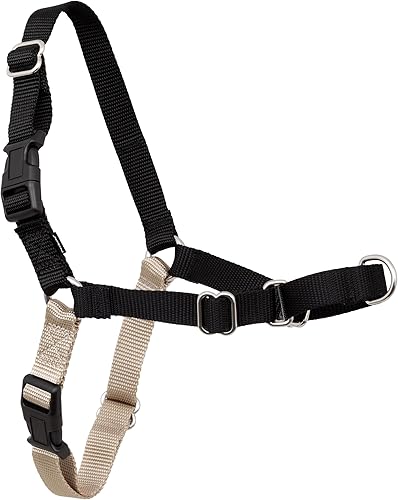
Sold and shipped by Amazon.com.
The Easy Walk is a strap harness rather than a vest: nylon, 3.88 ounces, and designed to rest across the chest instead of the throat. The leash attaches at the front, and a martingale loop tightens to put gradual pressure on the shoulders when the dog pulls, according to the listing.
Quick-snap shoulder straps and a different-color belly strap make it easier to put on, per the listing. The medium is listed for dogs of 20 to 50 lbs (9 to 23 kg). The listing says it was created by a veterinary behaviorist in 2004.
Good to know
- Lightest of the three at 3.88 oz
- One-year warranty listed
- Quick-snap shoulder straps, per the listing
Keep in mind
- Front attachment only; no back ring is described
- Its claims to "safely and effectively stop pulling" are the brand's, not a study's
- Hand wash only
2 Hounds Design Freedom No-Pull Harness (1" MD)

Sold by WishingUWell, ships from Amazon.
The Freedom has two leash connection points, including a front O-ring, and four adjustment points. The listing says it is lined with Swiss velvet, uses stainless steel hardware and nylon webbing, and is made in the USA.
The listing mentions a "hassle-free chewing replacement warranty"; it doesn't give the terms. Sizing is by chest measurement, and the medium fits a 24 to 28 inch chest. The leash is not included.
Good to know
- Two leash connection points
- Chewing replacement warranty, per the listing
- Machine washable
Keep in mind
- Harness only; leash not included
- The spec table lists breed size as Medium and breed recommendation as Large Breeds
- "Trusted by veterinarians", "never rust" and "will not break" are the listing's claims
Side by side
| Product | Style | Leash points | Size shown | Material |
|---|---|---|---|---|
| rabbitgoo | Padded vest, overhead | Front + back | Medium: 10–25 kg | Polyester oxford, mesh |
| PetSafe Easy Walk | Strap, martingale loop | Front | Medium: 20–50 lbs | Nylon |
| 2 Hounds Design Freedom | Strap, velvet-lined | Two, incl. front O-ring | MD: 24–28 in chest | Nylon webbing + velvet lining (bullets); spec says velvet |
Specs as stated on each Amazon listing, checked September 2026.
What to look for
Where the leash clips
All three harnesses here clip at the chest, and the Easy Walk adds a tightening loop. No study we found shows a chest clip reduces pulling on its own; the 2025 study that found harder pulling in a harness used a back clip [2].
Fit by measurement
Every listing here says to measure first. The 2 Hounds listing says to measure around the largest part of the chest.
Flat-faced breeds
In a small 2025 study (10 flat-faced and 10 long-nosed dogs), a collar raised eye pressure and a harness did not. But the harness also raised flat-faced dogs' breathing rate during exercise, about as much as the collar did [1].
Training still matters
No study we found shows a harness stops pulling on its own. We'd pair any harness with loose-leash training.
The bottom line
- Best Overall: The rabbitgoo vest gives you front and back rings plus a handle, and has the most ratings of the three.
- Best Lightweight Front-Clip: The PetSafe Easy Walk is the lightest of the three (3.88 oz) and clips at the front only.
- Best Velvet-Lined: The 2 Hounds Design Freedom adds a velvet lining, two connection points and a chewing warranty, per the listing.
Questions pet parents ask
Do no-pull harnesses actually work?
We found no study showing that front-clip "no-pull" harnesses reduce pulling on their own. Two studies found dogs pulled harder in a harness than in a collar: one used a back-clip harness [2] and one a chest harness with shelter dogs pulling toward food [3]; neither tested front-clip "no-pull" designs as such. We'd treat a front-clip harness as a management tool alongside training.
Is a harness better than a collar?
It depends on the dog. A small 2025 study of 20 dogs found collars raised eye pressure, most of all in flat-faced breeds, while harnesses did not, but the harness also raised flat-faced dogs' breathing rate during exercise [1]. Two small studies found dogs pulled harder in a harness than a collar under their test conditions [2][3], and a 2026 review found that every harness type studied has affected gait [4].
Do collars damage a dog's trachea?
A 2026 review found claims that leash-pulling on a collar damages the thyroid or trachea are not supported by the literature, though severe injuries from misuse are documented [4].
What size harness does my dog need?
Measure the chest at its widest point and check the listing's size chart. For example, the 2 Hounds Design medium fits a 24 to 28 inch chest.
Can I leave a harness on all day?
The listings we checked don't address all-day wear. Ask your vet or trainer, and check the fit for rubbing.
Sources
- Bailey ME, Packer MJ, Wills AP. Effect of a Collar and Harness on Intraocular Pressure and Respiration Rate of Brachycephalic and Dolichocephalic Dogs. Veterinary Medicine and Science (2025). doi:10.1002/vms3.70384. pmc.ncbi.nlm.nih.gov
- Bailey J, Discepolo D, Baker J, Perry E. An investigation of force potential against the companion dog neck associated with collar use. Journal of Veterinary Behavior 78:19–24 (2025). doi:10.1016/j.jveb.2024.10.007 (abstract read). sciencedirect.com
- Shih HY, Phillips CJC, Mills DS, Yang Y, Georgiou F, Paterson MBA. Dog Pulling on the Leash: Effects of Restraint by a Neck Collar vs. a Chest Harness. Frontiers in Veterinary Science (2021). pmc.ncbi.nlm.nih.gov
- Ridgway M. Health implications of dog-worn equipment: a review of known and alleged physical risks. Frontiers in Veterinary Science (2026). doi:10.3389/fvets.2026.1711781. frontiersin.org